How to split costs at a holiday cabin when every family has a different number of children
Three families, one cabin for four nights. The Smiths have two children, the Browns one, the Taylors none. At the end of the stay there is €1,050 of costs on the table and one question: how do you split it so that nobody feels they are paying for the others?
The short answer: each kind of cost is split differently. The cabin is paid per bed, food by how much people eat, and wine only by those who drink it. Below it is worked through with real numbers.
Why thirds and per head do not work
The quickest way is to take the total and divide it by three. But then the Taylors pay as much as the Smiths, although there are half as many of them. Splitting per head treats a five-year-old like an adult, for food and for wine alike.
With the costs from the example it looks like this:
| Family | Thirds | Per head | By kind of cost |
|---|---|---|---|
| Smiths (2 + 2) | €350.00 | €466.67 | €448.00 |
| Browns (2 + 1) | €350.00 | €350.00 | €350.00 |
| Taylors (2 + 0) | €350.00 | €233.33 | €252.00 |
Between the first and the last column the Taylors' share differs by almost €100. At that amount it pays to agree in advance.
The example: what was paid and how it splits
There are nine people altogether: six adults and three children. Three things were paid.
The cabin for 4 nights: €720, paid by the Smiths. The owner charged per person, so the families split it per person too: €720 / 9 = €80 each. Smiths €320, Browns €240, Taylors €160.
Groceries: €270, paid by the Browns. Here children pay half. An adult counts as 1, a child as 0.5:
- Smiths: 2 + 2 × 0.5 = 3
- Browns: 2 + 1 × 0.5 = 2.5
- Taylors: 2 + 0 = 2
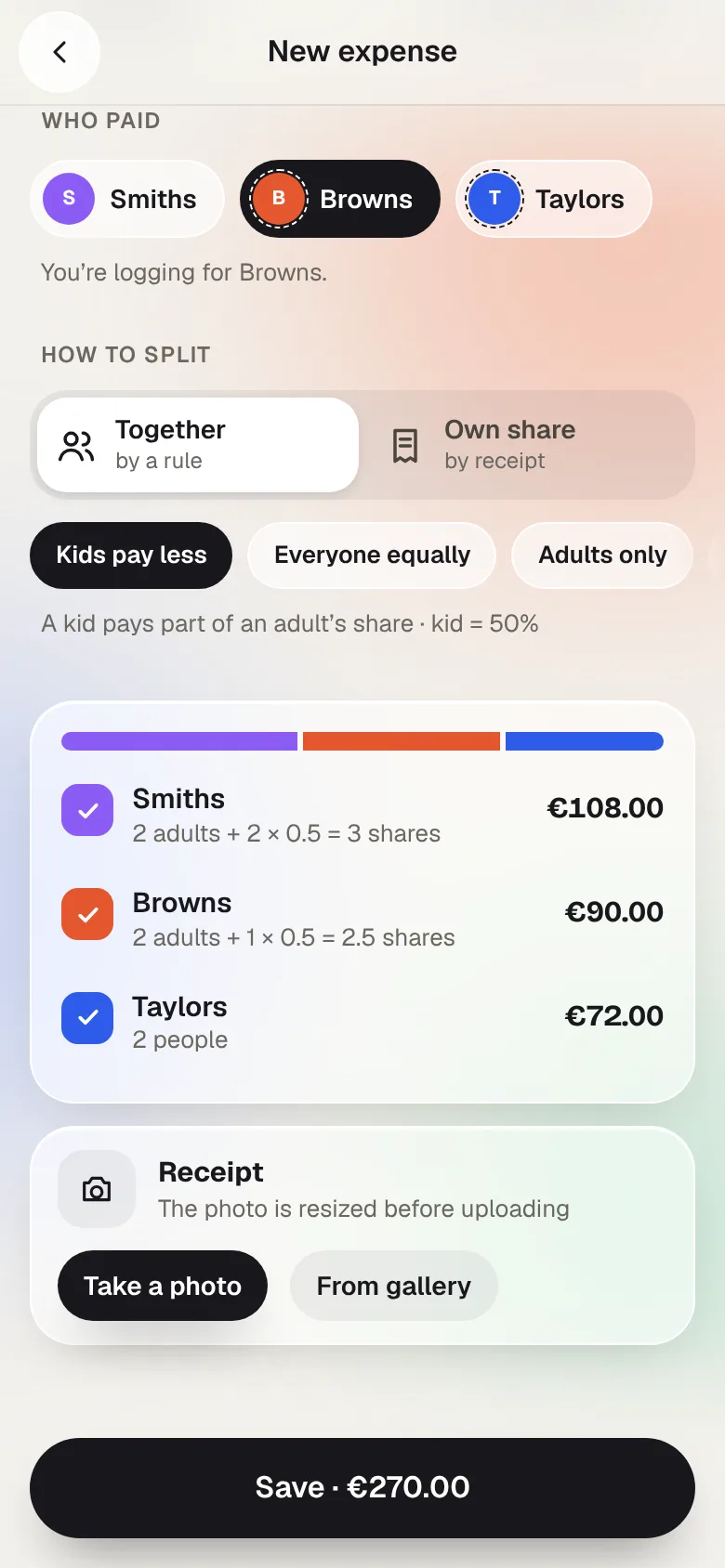
That is 7.5 shares in total, one share is €270 / 7.5 = €36. Smiths €108, Browns €90, Taylors €72.
Wine and beer: €60, paid by the Taylors. Split between adults only: €60 / 6 = €10 per adult, so €20 per family.
Who sends whom how much
For each family, add up what it paid and what its share is:
| Family | Paid | Their share | Difference |
|---|---|---|---|
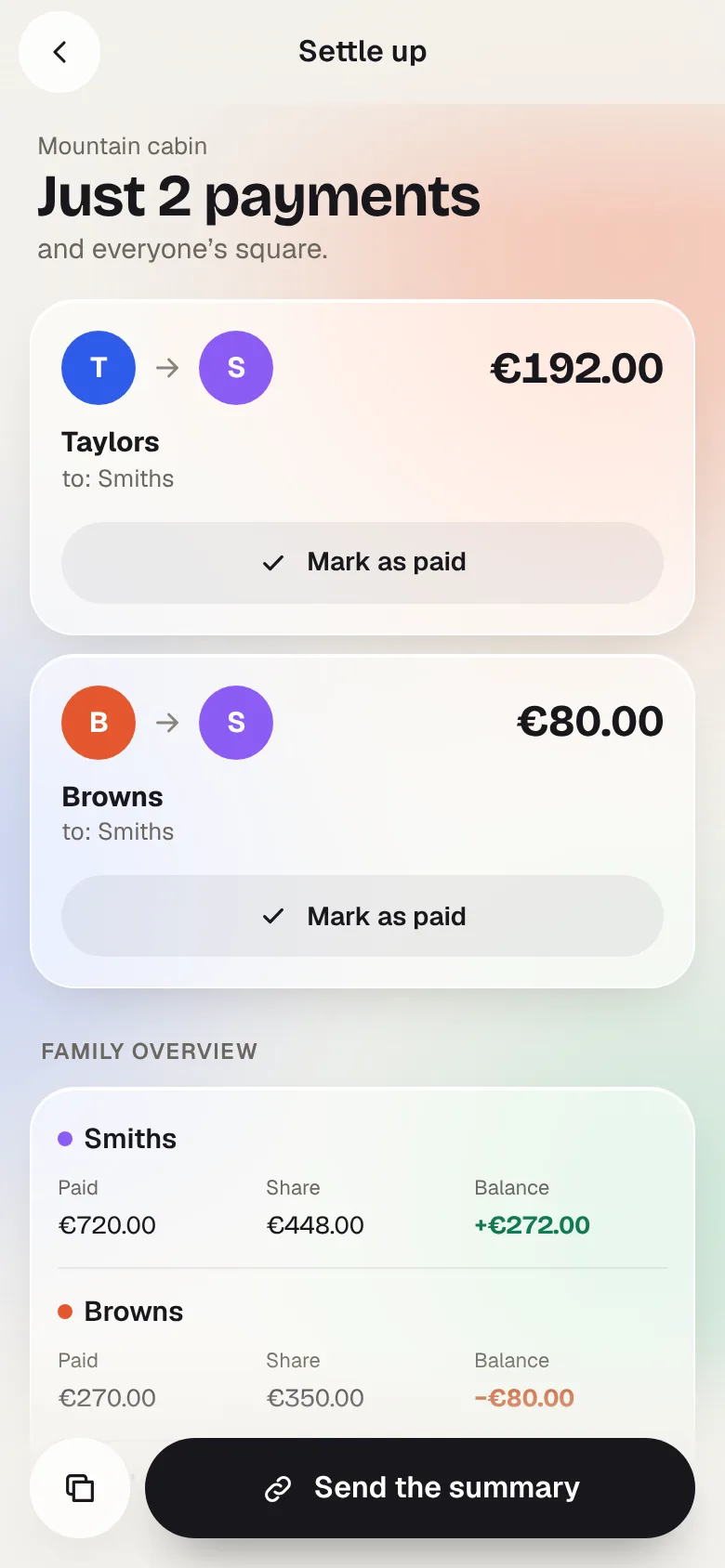
| Smiths | €720 | €448 | +€272 |
| Browns | €270 | €350 | −€80 |
| Taylors | €60 | €252 | −€192 |
The differences add up to zero, so the maths is right. Two transfers are enough: the Taylors send the Smiths €192 and the Browns send the Smiths €80. Nobody has to pay everybody. It is enough that those in the minus pay those in the plus.
Rules worth agreeing on before you leave
- Accommodation per person. If the owner charges children less, split in the same ratio. If someone arrives later, count person-nights: a family that stays two nights out of four pays half.
- Food and groceries: children at half. It is simple and most families find it fair. You can leave toddlers out entirely and count teenagers who eat more than their dad as adults.
- Alcohol between the adults only. Leave out anyone who does not drink.
- Fuel per family or per car. If every family drives its own car, fuel is not shared. If several families travel in one car, it is split between them.
- Trips and tickets by who went. Whoever skipped the water park does not pay for it.
Which rule you pick matters less than agreeing on it before you go. At the end of the stay it is hard to argue about whether a child should pay half or a third.
How to do it in Spolu
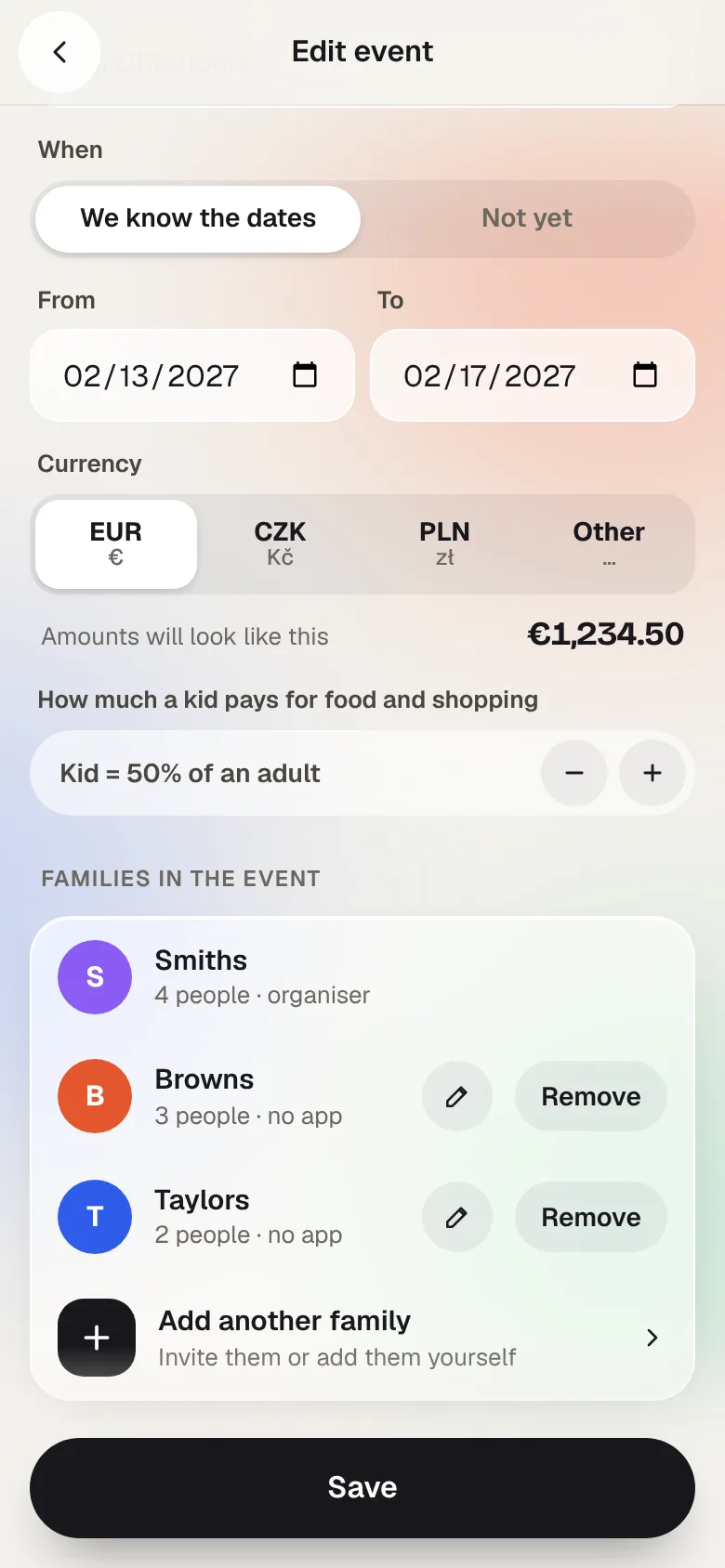
- Create an event and enter the number of adults and children for each family.
- In the event settings, set how much a child pays for food and shopping. The default is 50% of an adult.
- Pick a category for each expense. The split follows it: Food and Groceries “Kids pay less”, Accommodation per person, Transport per family. You can change it for any single expense.
- Untick any family an expense does not concern.
- At the end, open the settlement. Spolu shows the fewest transfers, each with a payment QR code or the bank details to copy.
Every family logs its own expenses, so nothing has to be pieced together from memory at the end of the stay.
Spolu does exactly this maths. It is free and runs in your browser.
Try Spolu