Shared food at a holiday cabin: a kitty, taking turns or everyone their own?
When several families share a cabin, they usually cook together. Sooner or later every group asks how to chip in for food. Families tend to do it in one of three ways, and each has a weak spot.
Three ways to chip in
A kitty. Every family puts in the same amount, one person shops and pays from the kitty. It is simple, but the same amount makes no difference between a couple and a family with three children. At the end you still have to work out who gets the leftover back or who has to top up.
Taking turns. Each family takes one day: shops and cooks. Nobody counts anything as long as the days are similar. But a stew for twelve costs more than pasta with sauce, and when there are more families than days, someone never cooks.
Everyone their own. Each family shops for itself. Nobody owes anybody, but the fridge has three blocks of butter and four packs of ham, and the shared dinner still has to be bought by someone.
What works best is a mix: shop together, log every shop, and settle at the end by the rule you agreed on. It does not matter who goes to the shop or how often.
What to agree on before you leave
- A menu and a list. Who does not eat what, who is vegetarian, what the children will not touch. It saves money and arguments.
- How food is split. Most often with children at half, with small children even less.
- Alcohol separately. It is split only between those who drink. Whoever does not drink does not pay for the wine.
- Special items, each family its own. Gluten-free bread, baby food or a favourite cereal the family buys and pays for itself, or leaves out of the split.
Example: three families, three shops
The Smiths (2 adults, 2 children), the Browns (2 + 1) and the Taylors (2 adults). Each family went shopping once:
- Smiths: €96
- Browns: €132
- Taylors: €72 for food and another €60 for wine and beer
The Smiths do not drink, so the alcohol is split between the Browns and the Taylors only.
Food, €300 in total, children at half. The Smiths have 3 shares, the Browns 2.5, the Taylors 2, so 7.5 shares at €40. Smiths €120, Browns €100, Taylors €80.
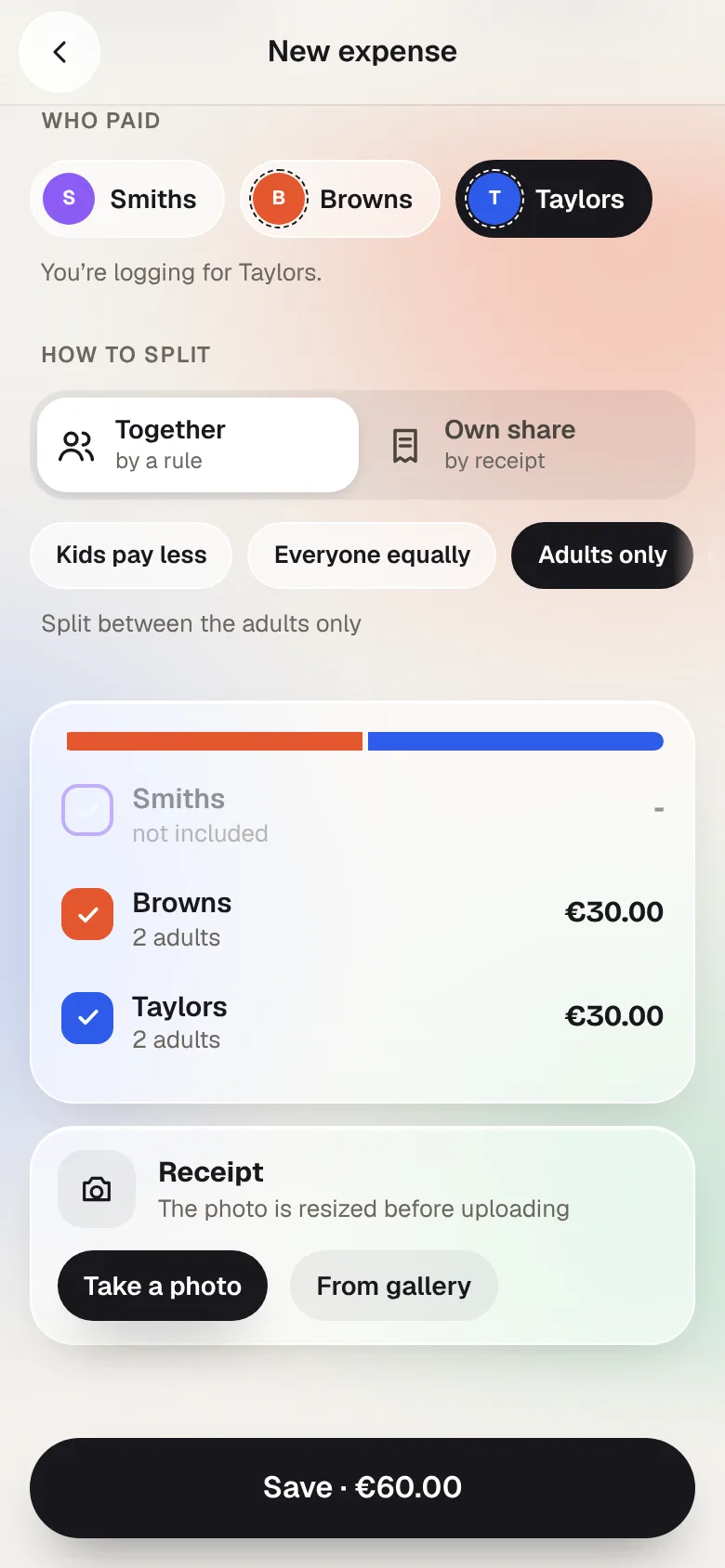
Alcohol, €60, between four adults at €15, so Browns €30 and Taylors €30.
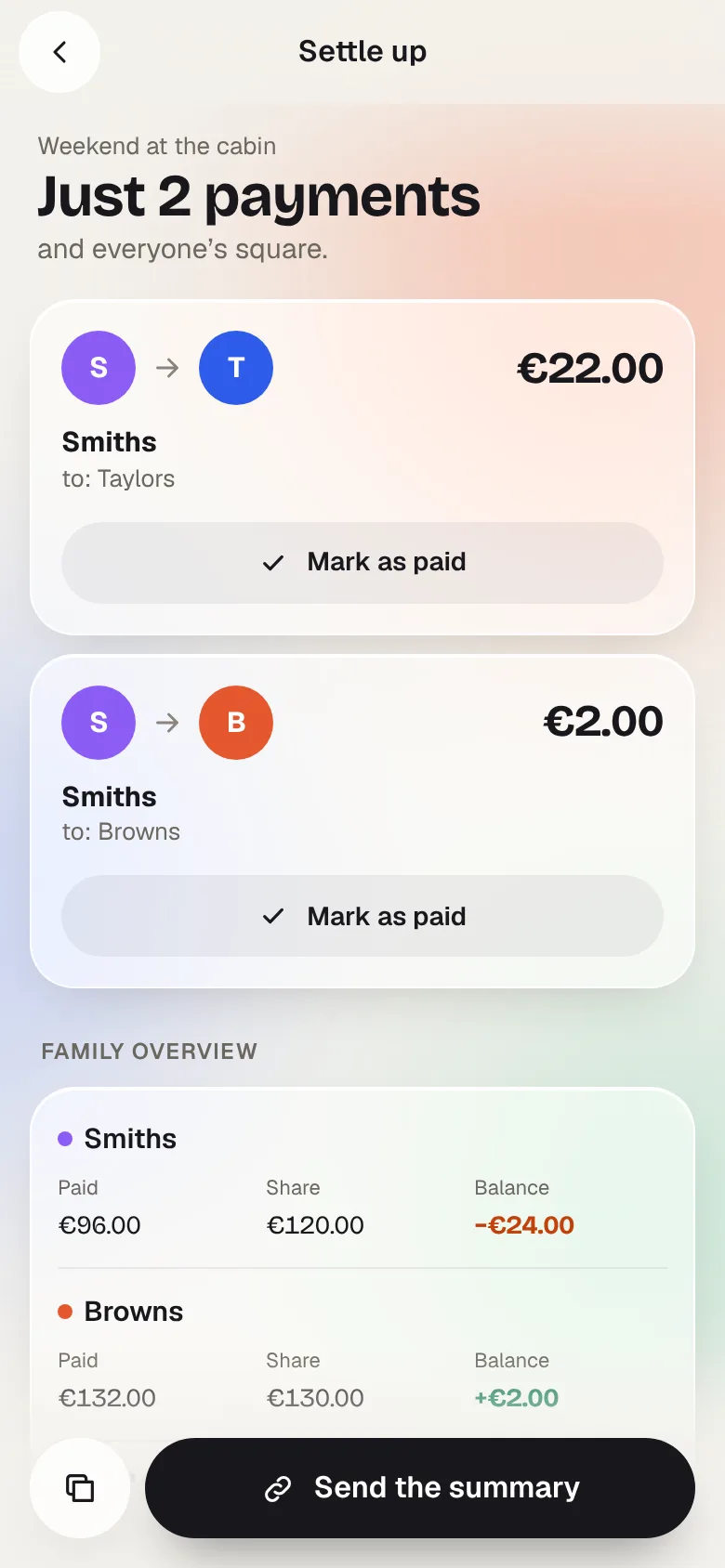
| Family | Paid | Their share | Difference |
|---|---|---|---|
| Smiths | €96 | €120 | −€24 |
| Browns | €132 | €130 | +€2 |
| Taylors | €132 | €110 | +€22 |
The Smiths send €22 to the Taylors and €2 to the Browns. With a kitty of €100 per family, the Taylors would have paid €20 more for food than they ate. And if the kitty had paid for the alcohol too, the Smiths would have paid for it without drinking any.
How to do it in Spolu
- Whoever shops logs the expense straight away, in the shop or while unpacking. Food and Groceries are split with children at half automatically.
- Log alcohol as a separate expense, choose “Adults only” and leave out the family that does not drink.
- Special items for one family: either do not log them at all, or keep only that family on the expense.
- At the end of the stay, open the settlement. Spolu shows who sends whom how much.
When one family paid a bill and everyone should pay only their own part, see one bill, everyone pays their own share.
Spolu does exactly this maths. It is free and runs in your browser.
Try Spolu